“The past is in the valley, the future in the mountains”
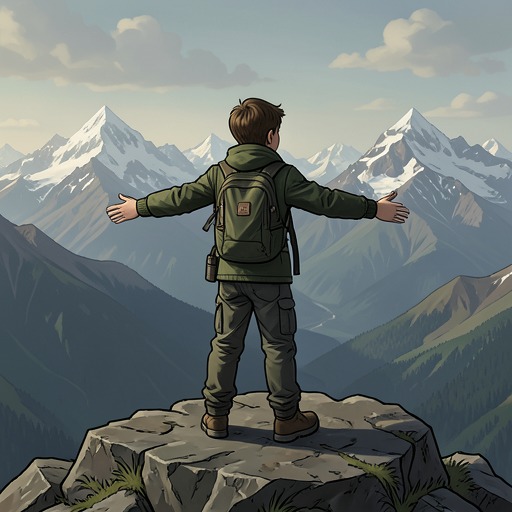
The Eight Mountains: A Novel“The past is in the valley, the future in the mountains” is the answer Pietro arrives at after initially misreading a river as a simple image of time moving forward. The phrase reverses the expected direction of the future: instead of lying downstream, it comes from above, where the mountains hold both the sources of the river and the uncertainties still to come. What begins as one of Giovanni Guasti’s riddles becomes a governing image for memory, landscape, and the movement of Pietro’s understanding.
The river riddle
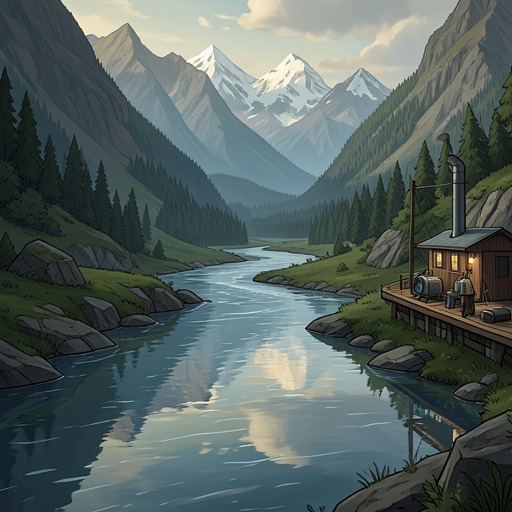
When Pietro and Giovanni are together, Giovanni asks whether the past can happen again. He frames the question through the river beside them, inviting Pietro to imagine its water as time and to locate the future in relation to the present. Pietro gives the obvious answer: the future is downstream, where the water is going. Giovanni declares him wrong, “Fortunately.” The brief exchange turns a familiar image of time into a problem that requires a different point of view.
That night, Pietro returns to the question while trying to sleep. His thoughts follow the river’s pool and waterfall, the trout holding position against the current, and the leaves and twigs carried elsewhere. He realizes that, for a fish, what matters comes from upstream: insects, branches, and leaves arrive from the direction the fish faces. The river is therefore not only a stream passing away from the observer. It is also a source of what is about to arrive.
Pietro’s revised answer gives the phrase its precise meaning: “the past is the water that has flowed past you, that which has gone downstream and where there is nothing left for you; whereas the future is the water that comes down from above, bringing dangers and surprises.” The valley is where the water has passed; the mountains are where it gathers before descending. Pietro concludes that whatever destiny may be, it resides in the mountains above them. The image makes the future less a destination chosen in advance than an incoming force, carrying unforeseen possibilities and risks.
Landscape as accumulated time
The phrase also fits the mountain country Pietro inhabits, where human history remains visible in the land even as it recedes. With Bruno, he explores abandoned stables, haylofts, granaries, shops, and houses in Grana. Some still contain a table, a bench, or kitchen utensils, traces of ordinary life left behind. In 1984, only fourteen people lived in the village, compared with as many as one hundred in the past. The valley holds the material remains of lives that have passed, but those remains are not fixed: buildings decay, and the land changes around them.
On climbs with his father, Pietro sees higher settlements that are abandoned or nearly so. Their flattened ground, collected stones, irrigation ditches, and terraced riverbanks record generations of work. Giovanni explains that settlers who arrived from the north of the Alpine region in the Middle Ages cultivated land where others had not ventured, enduring cold and deprivation through techniques that once made self-sufficient life possible. Pietro cannot imagine choosing such a hard existence, and his father offers clues rather than a ready-made answer. The past is legible in the terrain, but understanding it requires an effort of imagination.
That history is not a simple story of permanent human mastery. Bruno’s uncle predicts that the pastures could become wooded again; Pietro pictures weeds and shrubs spreading until they erase the ditches, drystone walls, paths, and eventually the houses. Years later, larch saplings are indeed springing up across the pastures. The prediction gives the landscape its own temporal motion: cultivation can be undone, and what seems settled may be reclaimed. The valley is not merely a storehouse of human memory but a place where traces can disappear and earlier conditions return.
The river changed, the phrase revised
Pietro’s later return to Grana makes the river’s metaphor concrete in another way. Beyond the village, its bed has grown at least twice as wide as he remembers, as though a gigantic plough had turned it over. Farther up, a landslide has carried down trees and rocks; even four years later, the unstable ground gives way beneath their feet. Bruno leads across the mud, rocks, and fallen trunks without turning around, and says that the path is gone and that he may now be the only person who comes that way. The river and mountain are not still scenery around a remembered past: flood and landslide have physically rewritten the routes through it.
In autumn, Pietro sees the river again under different conditions. Ice forms slides and galleries over the wet stones, catches dry grass, and turns it into shapes. Across these scenes, the river is at once a marker of time, a changing feature of the landscape, and a source of what arrives from upstream. The original riddle does not give Pietro control over change; it gives him a way to recognize that the present is being shaped by forces coming toward it, including forces that can remake the ground beneath familiar paths.
Memory carried into the mountains
As an adult, Pietro encounters his father’s mountain map still pinned to the wall. Over twenty years, Giovanni has filled it with routes until it resembles a biography more than a trail map. Pietro deciphers its black, red, and green lines: black marks Giovanni’s journeys, red accompanies him on climbs with Pietro, and green identifies Bruno. Some routes record shared climbs; others show Giovanni continuing alone. The map makes the past visible as accumulated journeys, while its lines also disclose relationships and absences that Pietro had not fully understood.
The mountain records continue this work of recollection. On a summit, Pietro finds Giovanni’s 1997 entry in the Grenon summit logbook: “Climbed up from Grana in 3 hours and 58 minutes. Still in great shape!” The brief note preserves not just a name and date but the father’s humor and pride in his strength. Pietro imagines Giovanni alone on the ascent, hurrying to reach the top in under four hours. The summit is a place from which the past can be encountered again, not by reversing time but by finding its trace in a record left in the mountains.
Pietro later understands his father through the image of the glacier, which Giovanni described as the snow of winters long past: a memory that summer has not erased. That understanding helps Pietro distinguish the father he knew in the city from the man he had glimpsed in the mountains, the one who walked behind him on the paths and loved glaciers. He chooses to rebuild the ruin his father left him as a way of remembering that second father. The phrase’s movement from valley to mountain thus becomes more than a riddle about the direction of time: the mountains hold both what has not yet arrived and the records through which the past can still be recovered.